

Every EAM vendor will show you a feature demo. They'll talk about AI, dashboards, SAP integration, and other important features.
But none of them generate ROI if your technicians go back to SAP GUI on laptops or even paper and phone calls within three months.
This is the part of the business case that most buyers skip over. You model the savings, pick the vendor, sign the contract, and assume adoption will follow. It usually doesn't.
The adoption problem is worse than you think.
The numbers on enterprise software adoption are brutal. Gartner predicts that more than 70% of recently implemented ERP initiatives will fail to fully meet their original business goals, with low end-user adoption cited as a primary reason.
The world's 500 largest companies lose roughly $1.4 trillion annually to unplanned downtime.
Meanwhile, the problem those systems are supposed to solve is getting more expensive. Siemens' True Cost of Downtime 2024 report found that the world's 500 largest companies lose roughly $1.4 trillion annually to unplanned downtime, equivalent to about 11% of their yearly revenues. ABB's Value of Reliability survey found that two-thirds of industrial businesses deal with unplanned downtime at least once a month, at a cost averaging $125,000 per hour.
And yet, the software purchased to address this problem sits underused.
The question isn't whether EAM software can reduce downtime. The question is whether your specific team, in your specific plants, will actually open the app.
What low adoption costs you.
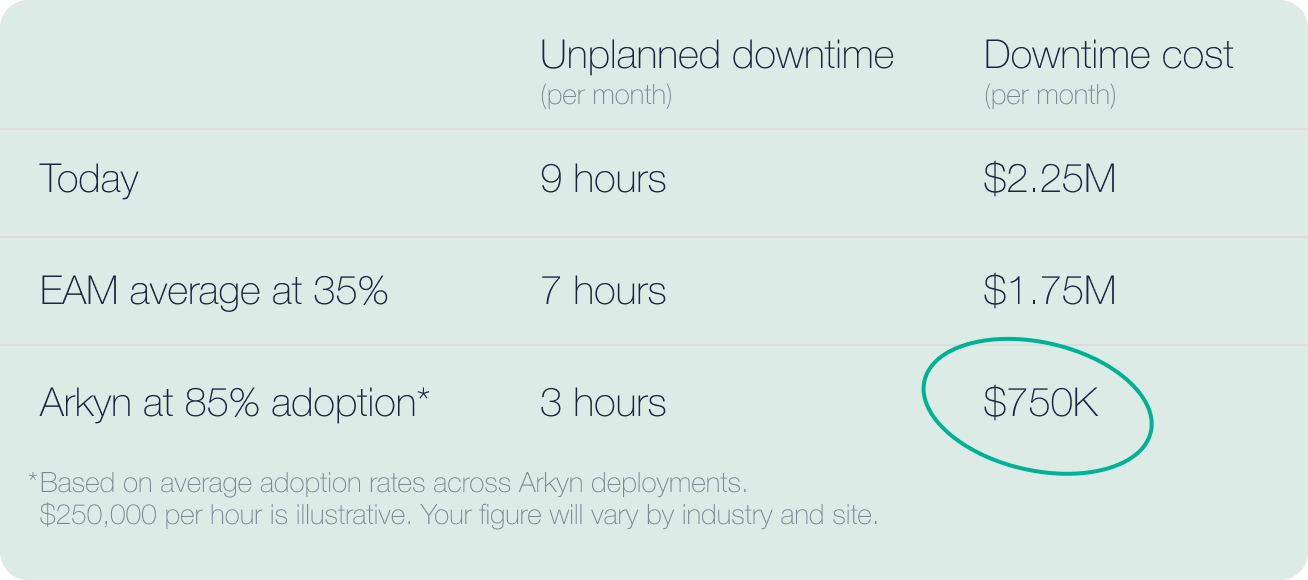
Let's make this concrete. Take a site where unplanned downtime costs $250,000 per hour, and you're currently seeing about 9 hours of unplanned downtime per month. That's $2.25 million a month walking out the door.
Now you roll out EAM software. If your adoption rate lands at the industry average of around 35%, you might reduce downtime to 7 hours a month. That's $1.75 million. You moved the needle by $500,000, but you're paying full license cost for 35% of the result.
At 85% adoption, the same software drives downtime down to 3 hours a month. That's $750,000. Compared to the 35% scenario, that's an extra $1 million recovered every month. Same software, same features, same price.
Adoption is not a soft metric. It's a multiplier on everything else in your business case.
Run the numbers for your operation with our EAM software ROI calculator.
Why EAM adoption fails.
If adoption matters this much, why does it fail so often? In the SAP maintenance world, the reasons are predictable.
The software is too complex. SAP's native mobile tools (SAP Asset Manager, Fiori) are powerful on paper but notoriously difficult to use in the field. Technicians working in a plant, on a rail track, or inside a tank don't have time to navigate a complex interface. If the app is slower than calling the planner, the planner gets the call.
The implementation takes too long. Many EAM deployments take 6 to 18 months. By the time you go live, requirements have changed, the project team has moved on, and users are already skeptical. The longer the rollout, the harder it is to build momentum.
Offline doesn't really work. Technicians work in areas with no signal: underground, in remote facilities, inside metal enclosures. If the app can't handle that gracefully, data doesn't get captured. If data doesn't get captured, planners don't trust the system. If planners don't trust the system, everyone reverts to Excel.
It creates more admin, not less. The whole point of mobile EAM is to reduce administrative work. But many implementations add steps rather than removing them. If a technician has to enter data in the app and then call it in as backup, you've doubled the workload.
What to ask your EAM vendor.
When you're evaluating EAM software, the feature comparison matrix is the least useful document on the table. Every vendor checks the same boxes. Here's what actually predicts whether you'll see ROI:
What's your go-live timeline, with real users? Not a pilot with five hand-picked technicians. A production deployment with hundreds of users executing real work orders. If the answer is "6 to 12 months," ask how they plan to maintain momentum.
What adoption rate do your customers see? This is the question most vendors can't answer. If they can, ask what they measure and how. Active daily users is the only metric that matters. Licenses sold is not adoption.
How does it work offline? Not "does it support offline" but "what happens when a technician works a full shift without signal and then syncs?" If the answer involves manual steps or conflict resolution, it won't survive the field.
How much SAP training do technicians need? If the answer is "we recommend a two-day training course," the UX is too complex. Technicians should be able to open the app and start working.
What happens when you scale? Performance with 50 users and 1,000 assets is not the same as 1,000 users and 100,000 assets. Ask what happens to load times and sync reliability at your actual scale. If a technician tries to open a work order app and it doesn't work or is slow to sync, then they will eventually give up and revert to tried and true methods of getting work done.
What drives 85% adoption at Arkyn.
Every point above is a failure mode we designed around. Here's what that looks like in practice.
"You can pick it up and immediately understand how to navigate and use it."
Randall Grogan, Sr Director of IT SAP & Financial Applications at Energy Transfer
The adoption rate starts with what happens on day one. FastWork, our mobile work execution app, is native iOS and Android. Not a SAP Fiori screen wrapped in a mobile shell. The UX is built for someone wearing gloves on a factory floor or out in the field, not someone sitting at a desk. Randall Grogan, Sr Director of IT SAP & Financial Applications at Energy Transfer, put it this way: "You can pick it up and immediately understand how to navigate and use it." If you'd like to know more, you can read the full Energy Transfer success story here: How Energy Transfer mobilized SAP maintenance for 8,000+ technicians.
That simplicity matters because it removes the biggest adoption killer: training requirements. When a technician can open the app and start reporting on a work order without a two-day course, you don't spend months coaxing people off paper.
Speed to go-live is the second piece. FastCloud, our SAP integration engine, ships with pre-built coverage for SAP PM and CS processes. You're configuring, not building from scratch. That's what makes 2 to 6 week go-lives real. A fast rollout means the tool is in people's hands while there's still momentum and organizational attention.
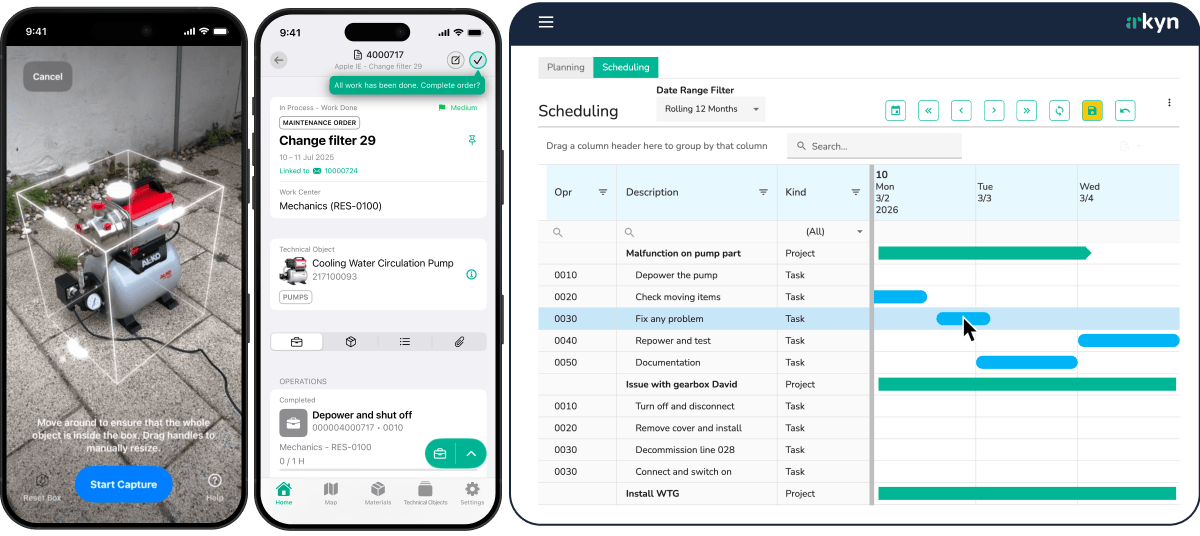
And the suite covers the full loop for SAP maintenance: FastPlan for planning and scheduling, FastForms for digital inspections, FastNotifications so anyone on site can report issues, and FastExternals for subcontractor work.
When every step of the workflow lives in one connected system that writes back to SAP, there's no reason to fall back to Excel and phone calls. Want to know more? You can browse the full Arkyn FastApp Suite suite here: FastApps from planning to execution to insight.
The numbers across Arkyn deployments:
- 15% more wrench time.
- 80% less admin work.
- 30% improvement in first-time fix rate.
Those results come from the adoption rate, not from a feature that 35% of your workforce never touches.
The real ROI question.
The next time you're building an EAM business case, don't start with the feature list. Start with the adoption assumption.
Model what happens at 35% adoption. Then model what happens at 85%. The gap between those two numbers is your real ROI, and it will dwarf any difference in license price.
Want to see what adoption is worth for your workforce? Try the calculator or get in touch with us for a no-obligation chat about how Arkyn can benefit your organization.