

At Sapphire 2026, SAP introduced the Autonomous Enterprise: AI agents that run business processes end-to-end, not just assist with them. It's the clearest signal yet that the future of SAP is software that doesn't wait for humans to drive it.
The Autonomous Enterprise (aka SAP's Autonomous Suite) vision spans every part of the SAP estate, from finance and HR to supply chain, procurement, customer experience, and asset management.
Because we work with SAP maintenance and reliability teams, this piece looks at what was announced, why SAP is making this bet, and what it will take to land from that angle.
What SAP actually announced.
The Autonomous Enterprise rests on three pieces: a data foundation, a suite of agents, and a new way of using SAP.
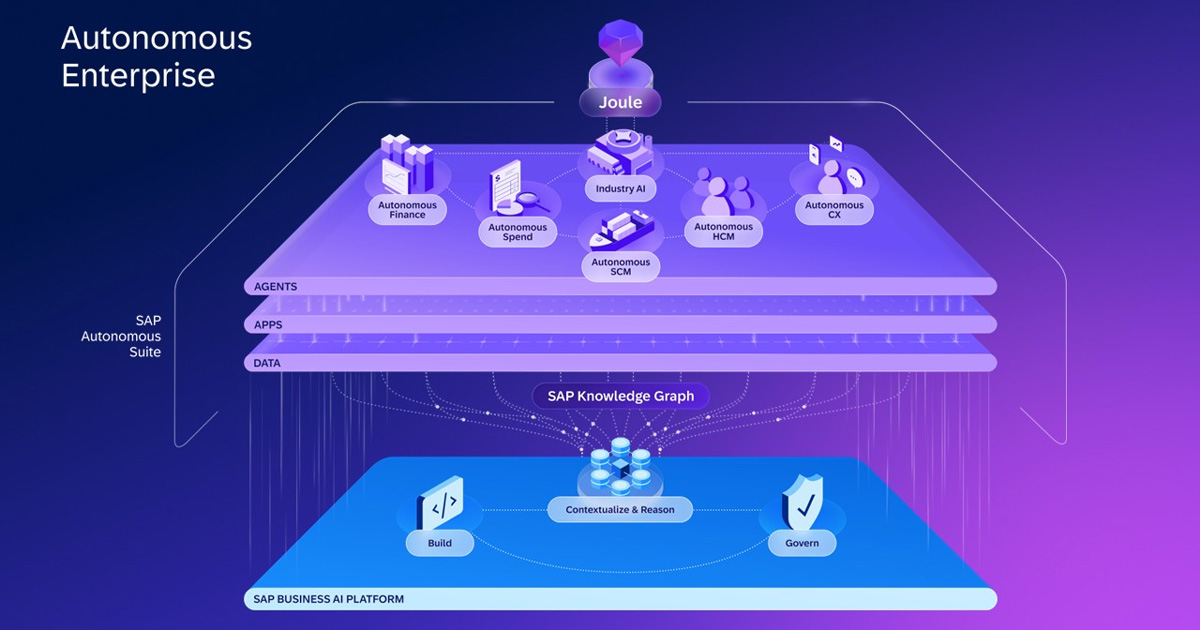
Together they form SAP's architecture for running the business with AI: the foundation gives the agents context, the agents do the work, and the new user experience is how people interact with both.
SAP Business AI Platform: the foundation.
This unifies three things that used to live separately:
- SAP Business Technology Platform (BTP).
- SAP Business Data Cloud.
- SAP Business AI.
At its core sits the SAP Knowledge Graph, a structured map of the entities, processes, and relationships inside your SAP landscape. The Knowledge Graph is what an AI agent needs to actually understand your business, rather than guess at it from generic patterns it picked up somewhere else.
SAP Autonomous Suite: the agents.
This is the layer that does the work. SAP plans to ship more than 50 Joule Assistants and over 200 specialized agents across finance, supply chain, procurement, HR, customer experience, and asset management.
The suite includes role assistants (financial close, hire-to-retire), domain assistants like the Asset and Service Assistant (planned for Q3 2026), and individual agents for narrower tasks such as Field Service Dispatcher, Asset Health, and Alert Processing.
Joule Work: the new user experience.
Joule Work is a different way of using SAP entirely. Instead of navigating apps and screens to complete a task, you describe what you want and Joule orchestrates the steps across SAP and non-SAP systems.
It works on desktop, mobile, and voice. SAP's framing is that you should stop asking your people to learn the software, let the software do the work, and ask the people only for the bits the software can't figure out itself.
Why SAP is making this bet now.

For most of its history, SAP has won by being the system of record. Every transaction, every work order, every payroll entry passes through it. That position is what has made SAP indispensable.
The AI era threatens to commoditize that position. Foundation models can read any data they are given. Cloud providers can store it. Workflow tools can act on it. If business AI becomes a question of who has the best model and the best chat window, SAP loses the structural advantage it has spent decades building.
SAP's answer is to make the data and process context that already lives inside its applications its moat.
Christian Klein put it directly at Sapphire: for the mission-critical processes their customers run, "almost right just isn't good enough."
The argument is that an AI agent grounded in real SAP master data, real transactions, and real process flows will outperform a generic agent every time. The Autonomous Enterprise is the architecture that turns that bet into a product.
What it looks like in practice.
Three examples from Sapphire give a sense of what SAP means by autonomy.
RWE's offshore wind operations.
SAP's flagship demo at Sapphire was an asset management scenario with RWE, the German energy giant. AI agents review thousands of past incidents across the wind fleet, identify the most likely root cause for a new fault, and generate pre-filled work orders with the right tools and proven fixes from other sites. The maintenance team sees a structured recommendation instead of a blank screen. RWE earned the keynote slot because it shows the vision working at scale on real assets.
This is the top stage of the maintenance maturity model working in practice. In our guide to the maturity model, we call it intelligent maintenance: the system reads incident history, asset health, and constraints, proposes the work, and people approve it. Almost no organization operates there today, and the gap is nearly always data rather than technology.
SAP Field Service and Asset Management (FSA).
SAP renamed its Field Service Management product to SAP Field Service and Asset Management.
The change is more than cosmetic. Some of the big updates are FSA gaining the planning capabilities of the older Multiresource Scheduling (MRS) product, a new Fiori-aligned interface, and Joule features.
There's a lot more to this pivot, which you can read about in our full explainer here: SAP Field Service and Asset Management (FSA) explained.
The €100 million partner fund.
SAP launched a €100 million fund for partners helping customers deploy AI assistants and agents, plus a separate fund for partners building agents on the Business AI Platform.
The headline is the number, but the real signal is the strategy. SAP is treating the Autonomous Enterprise as an ecosystem play, with partners delivering the execution, integration, and customer-specific work that wraps around the agents.
What has to be true for the Autonomous Enterprise to work.
Under everything SAP announced sits the condition that Autonomous Enterprise only works if the data feeding the agents is clean, current, and structured.
Almost right isn't good enough. An AI agent that is 92% accurate on a mission-critical process isn't 92% useful. It is confidently wrong 8% of the time, which is worse than no agent at all if you can't tell when it is wrong.

Or, as our CTO Rune Durhuus-Andersen succinctly puts it, "You can't run AI on data you don't have."
Poor maintenance data has always cost the business, but the Autonomous Enterprise raises the stakes. Reporting problems become execution problems when the agents act on what they read.
There's also an asymmetry across the SAP estate that explains why this matters more for asset management than for other domains.
Rune estimates that “SAP-based companies’ financial and logistics processes are around, say, 90% managed inside SAP today while asset management is closer to 20%. The rest of that lives in technicians' heads, supervisors' phones, and planners' spreadsheets. The industry has a name for this, it’s called tribal knowledge. And then there are separate IoT systems and stuff like that on top.”
The three maintenance data streams that feed SAP's AI agents.
Tribal knowledge is a major hurdle, and you can see why once you look at what an AI agent in maintenance actually reads.
It draws on three streams of data, and they are not equally mature.
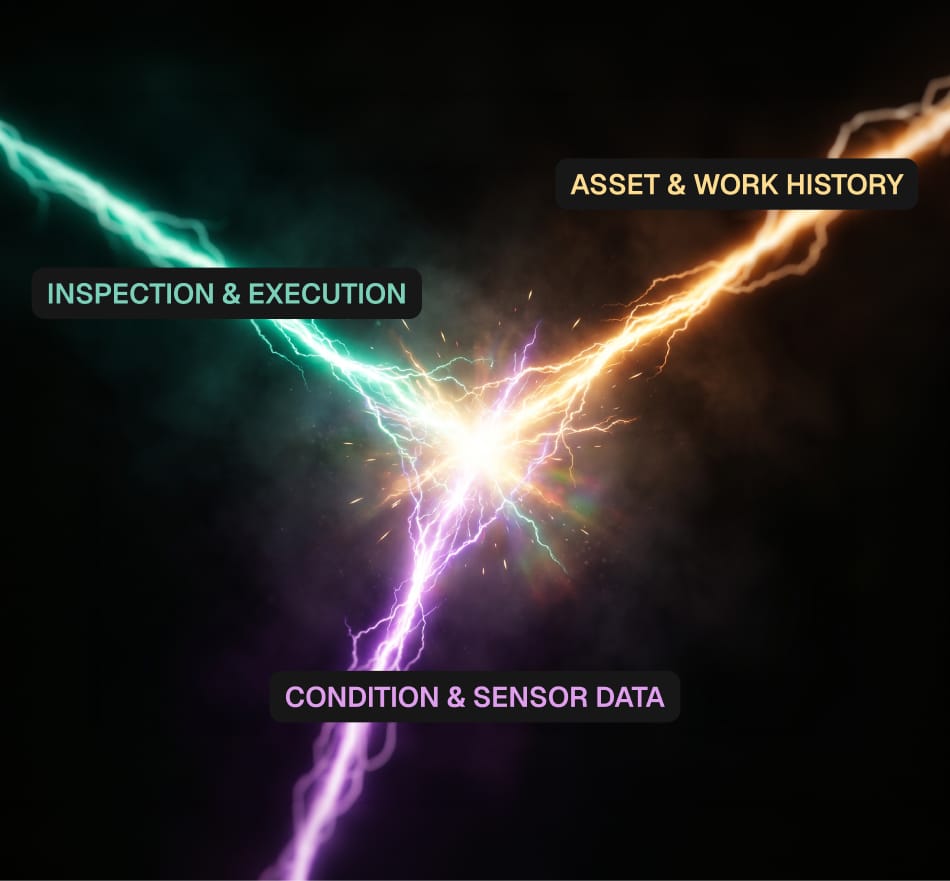
The three streams:
- Asset and work history. The equipment master, functional locations, notifications, and closed work orders already in SAP. Decades of investment sit here, and most SAP customers know its gaps.
- Condition and sensor data. Operating context and condition signals from sensors, SCADA, and other OT systems. Well understood, and increasingly connected through IoT platforms.
- Inspection and execution data. What technicians, planners, supervisors, and operators record while doing the work: Damage codes, time bookings, measurements, checklist results, and notifications.
The first two are increasingly well understood. The third is where most of the variance lives, and it's where this article and Arkyn as an organization focus. If you lead a maintenance organization, it's also the part of the Autonomous Enterprise you control.
Frontline data is created in small acts, every shift.
- A technician confirms a job and selects a damage code.
- A planner sequences work and assigns a craft.
- A supervisor signs off on a completion.
- An operator on the line raises a notification about an early sign of trouble.
Each of those small acts becomes data the agents will read tomorrow.
Poor frontline experience produces poor data.
The failure modes are not hypothetical.
- Defaults instead of detail. A slow work order app pushes technicians to accept defaults rather than tap through screens, because defaults are faster.
- Skipped damage codes. If the interface is hard to use with gloves and PPE on, the damage code is a field that is easy to skip.
- Verbal reports that vanish. An operator who spots an early warning sign but has no SAP credential flags it verbally, and there's no guarantee the report reaches your system of record.
- Rounded time bookings. Hours get rounded to the nearest hour because anything more precise costs time someone would rather spend on the actual work.
The agents work with what they are given, and what they are given is incomplete, inaccurate, and hours or days behind the real world.
We would argue that makes the frontline the single biggest variable in whether the Autonomous Enterprise vision lands. Not the model, the platform, or the architecture.
We dig into what that data layer takes in our article: Why the future of SAP maintenance starts at the frontline.
What this means for the next 18 months.
SAP set a clear direction at Sapphire. The vision is real, the agents are shipping, the partner ecosystem is funded, and the strategic logic is sound.
Customers running asset-heavy SAP landscapes will face a steady stream of AI-related decisions over the next year and a half: which agents to enable, which scenarios to pilot first, how to think about Clean Core, how to migrate off MRS, and what to do about FSA.

Underneath all of those questions sits a more basic one. Are your frontline workflows producing the kind of data an AI agent could trust? Two practical places to start looking: notification quality and damage code completion rates.
If yes, the Autonomous Enterprise becomes a multiplier on top of work that is already done. The agents have something to work with, and the value compounds.
If not, the most expensive part of the AI rollout will be the months spent discovering that the agents are confidently wrong, and that the data underneath them needs fixing before any of this works.
At Arkyn, we are building the Frontline OS for SAP maintenance teams: the planning, execution, and reporting layer that turns frontline work into the kind of data the rest of the SAP stack, and the Autonomous Enterprise agents on top of it, can actually use. Reach out to us if you'd like to discuss better field data for your autonomous enterprise future.