How a large European food manufacturer connected operators, machines, and data.

A food manufacturing success story.
A European food manufacturer with production across multiple continents adopted FastWork in 2022 after a lengthy search for a solution that matched their needs.
Four years later, more than 2,000 technicians and shop floor operators across 44 production sites use the app every day, and SAP data quality has followed.
The details at a glance:
The situation.
This company employs tens of thousands of people and operates production sites globally. Maintenance teams are responsible for production lines, utilities, and facility infrastructure. Their SAP Plant Maintenance (PM) system held the master data, but the shop floor needed to be connected. Technicians accessed SAP through desktop interfaces, and operators had no practical way to contribute to maintenance workflows from where they actually worked.
The company had used a mobile maintenance solution before. The supplier ended support for it, prompting the move to a replacement. That history made the team careful about the next commitment.
When they evaluated replacements, the requirements were clear:
Two user types (maintenance technicians and production operators).
Real-time access to notifications and work orders with no latency.
An architecture that could support their planned migration to S/4HANA.
Full offline capability.
Whatever came next had to work reliably from day one.
What they deployed.
In 2022, the company started with FastWork at a small number of pilot sites, with a plan to scale to 45-47 sites and 2,000+ users. The app was rolled out across Android and iOS devices for both technicians and operators, and available in five languages to support their multi-country workforce.
Today, FastWork is live at 44 production sites, with more than 2,000 unique users. Every new site that goes live on SAP PM includes FastWork from day one.
What changed.
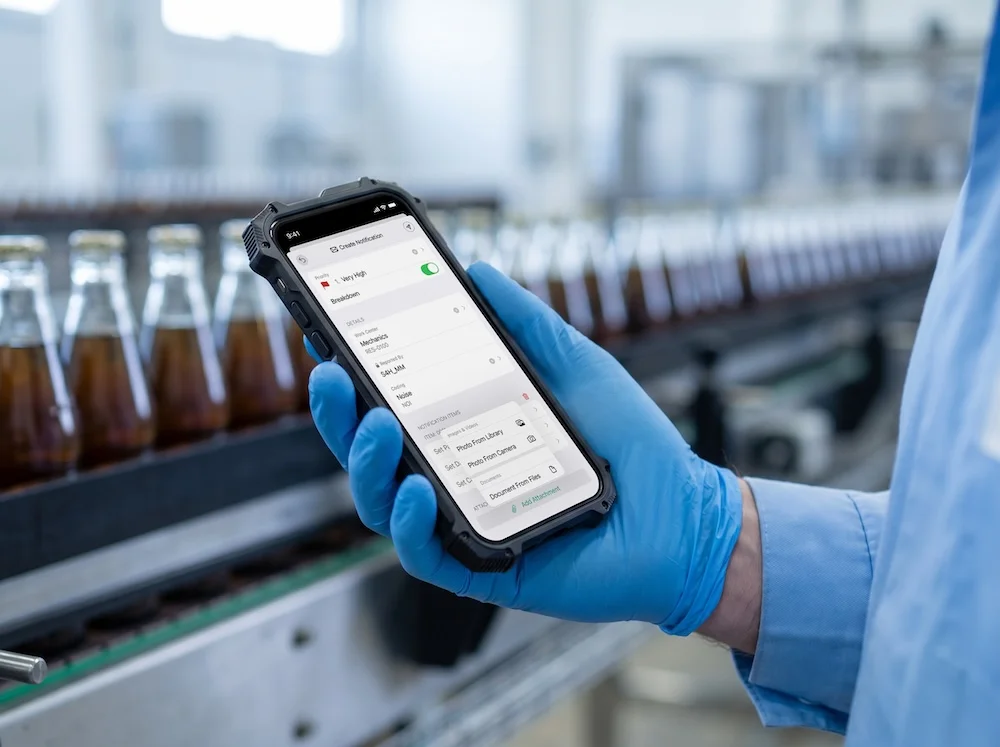
With FastWork, technicians can pull up work orders, report time and materials, and check asset history directly from their phone or tablet. Data reaches SAP as work happens, not hours or days later. On some sites the app replaced some of the desktop terminals and created alternatives to paper-based processes.
The result is that savvy technicians stopped logging into SAP. They use FastWork while SAP gets the data it needs in the background. One senior maintenance technician, who has been using the app since the beginning, said: "I pretty much don't use anything else for the functionalities that are in the app."
Many new employees who joined after the rollout have never used SAP at all. "We have people here who have no idea how the SAP system works because they're using the phone and that's enough for them. They don't need to use anything else. And here we're talking craftsmen, blacksmiths, electricians."
The company's head of maintenance excellence described the shift from the management side: previously, technicians would do the work, walk back to a workshop, log on, and try to fill in information from memory. Now they can report at the point of work. As he put it: "They're at the line, they are able to fill in the information then and there."
Specific features have earned trust through daily use.
The spare parts search is one example. "Everybody loves this feature about scanning out spare parts from the stock. It works perfectly." At larger sites, where some facilities are big enough that technicians use bicycles to get around, searching for parts at the machine instead of walking to a terminal saves an estimated 10 to 20 minutes per reactive maintenance job.
The ability to attach photos to notifications is another popular feature. In a 24/7 production environment where the person who reported an issue may be off shift by the time someone arrives to fix it, a picture with the right context changes how fast work gets done. "You're able to attach a photo to what the problem is, that's a big help for the guys who are supposed to come and fix it."
Improving uptime and decision making with data.
The biggest change is not a feature. It is the quality of information flowing into SAP.
One senior maintenance technician describes the importance of data quality with an effective analogy:
The same is true for maintenance notifications: without the right context, the technician cannot fix the issue.
FastWork improves context by making the fields that matter for maintenance mandatory. The information is structured, and it arrives with helpful context like photos and the correct functional location scanned via QR code, which "eliminates the possibility of choosing the wrong functional location."
The better the information in the notification, the faster the technician can find and fix the issue. That is an example of the direct line between data quality and uptime.
For a company running production lines around the clock, including Christmas Eve and Easter, the cost of getting this wrong is real. For fast-moving consumer goods manufacturers, an hour of unplanned downtime costs an average of $36,000, according to the Siemens True Cost of Downtime 2024 report. And when a plant runs at capacity, that production cannot be recovered.
Accurate maintenance data does more than speed up repairs.
Improved master data in SAP PM can also shape investment decisions. For example, when functional locations are captured correctly and maintenance history is complete, that data can become the basis for capital expenditure requests.
Connecting data, machine, and operator.
The company's maintenance excellence strategy is built on three priorities: globally standardized and data-driven maintenance focused on reliability, cost transparency, and strong execution discipline between planned and reactive work.
They track 12 KPIs across their sites, including OEE, maintenance cost per tonne, schedule adherence, and the ratio of preventive to reactive work.
FastWork supports that strategy by connecting operators directly to the maintenance process. As the head of maintenance excellence described it: "We're capturing the data at the machine with the operator, you know, we're connecting the three together, data, machine, operator."

Operators were part of the plan from the beginning. When the company evaluated mobile solutions, the requirements explicitly defined two user types: production operators and maintenance technicians. Operators would create and close notifications, while technicians would handle the full work order lifecycle.
In practice, giving operators access to FastWork changed the dynamic. Instead of walking to a PC to log into SAP and report an issue, they can raise it live at the machine. The head of maintenance excellence saw that this creates a sense of ownership: "I think the operator feels a little bit more ownership because they're physically located at the machine."
The improved data quality from the shop floor feeds directly into planning accuracy and compliance reporting. Planners work from current, complete information instead of reconciling paper records and chasing status updates.
This pattern, where operators detect and escalate issues directly from the shop floor, is what the maintenance industry calls operator-driven reliability. You can read our guide to operator-driven reliability for SAP maintenance teams for more on that topic.
Where it stands today.
FastWork is live at 44 production sites, technicians and operators use it daily, and SAP can get the data it needs without anyone logging into a desktop.
The senior maintenance technician who has been using the app since 2022 put it simply: "if they have nothing today, then FastWork is most definitely way, way better than just picking up the phone and calling somebody."
His advice for anyone considering it:
The company's head of maintenance excellence put it in the context of what he has seen across his career: "The app itself is a really nice app, it has a really, really nice interface, one of the best I've seen."
Running maintenance on SAP in manufacturing? See how Arkyn’s manufacturing maintenance software works for food and beverage plants and multi-site groups.
Reach out to us if you’d like to explore how our FastApp Suite can bring value to your maintenance operations.
Get in touch with us to see Arkyn in action.
Get in touch and see how the FastApp Suite improves maintenance processes and works with your SAP system.