

If your maintenance planning runs on SAP PM (plant maintenance) and a wall of spreadsheets, it's time to look at dedicated maintenance planning and scheduling software.
In this article, we rank five options: Arkyn FastPlan, Prometheus Planning and Scheduling (GWOS-AI), On Device Solutions myPlanner, Sigga Planning and Scheduling, and osapiens.
FastPlan is the pick for teams that want visual planning connected to SAP that can go live in weeks. Prometheus fits enterprises buying one platform across planning, permitting, and turnarounds. SAP's own products are the way to go if you prefer to stay entirely inside SAP. We cover them separately below rather than ranking them.
One thing before we start: we build FastPlan and it's part of our FastApp Suite.
Who this comparison is for.
This article is for teams that plan maintenance and use SAP PM or CS as their system of record.
You know these pains:
- Your work orders live in SAP, but your actual weekly plan lives in Excel or some other system, and the two drift apart until someone reconciles them.
- Every change means manual rework across sheets and systems.
- When a job finishes early, nobody frees up the hours, so spare capacity stays invisible.
Planning teams we talk to tell us that copying data between Excel and SAP can eat up to half of their planning time.
This guide compares the five realistic software solutions for that problem: what each one does, how it connects to SAP, what it costs, and who it genuinely fits.
Why listen to us?
We build maintenance software on top of SAP PM and CS for a living. Arkyn's FastApp Suite covers planning, execution, and insights for SAP PM and CS teams, and our mobile work order app FastWork supports asset-heavy companies globally, such as thousands of technicians at Energy Transfer.
That work puts us in demos and workshops with SAP maintenance planners every week. This article is built from what they tell us, combined with each vendor's own published materials.
What is maintenance planning and scheduling software?
Maintenance planning and scheduling software gives planners a visual management layer on top of the maintenance system of record.
The standard is a solution where you see orders, operations, capacity, and priorities in one place, move work with drag and drop, and send the finished schedule back to the system of record.
For SAP maintenance teams, the category splits three ways:
Independent planning solutions that connect to SAP and write schedules back to SAP PM. FastPlan, Prometheus, myPlanner, and Sigga work this way.
SAP's own scheduling products, RSH and MRS, licensed separately and running inside SAP.
CMMS platforms with SAP connectors, which plan in their own system and sync data with SAP. The example we have here is osapiens.
Why SAP GUI + Excel falls short for planning.
Standard SAP does include capacity leveling. The classic tool is transaction CM25, a planning table that ships with SAP, and works for basic load balancing.
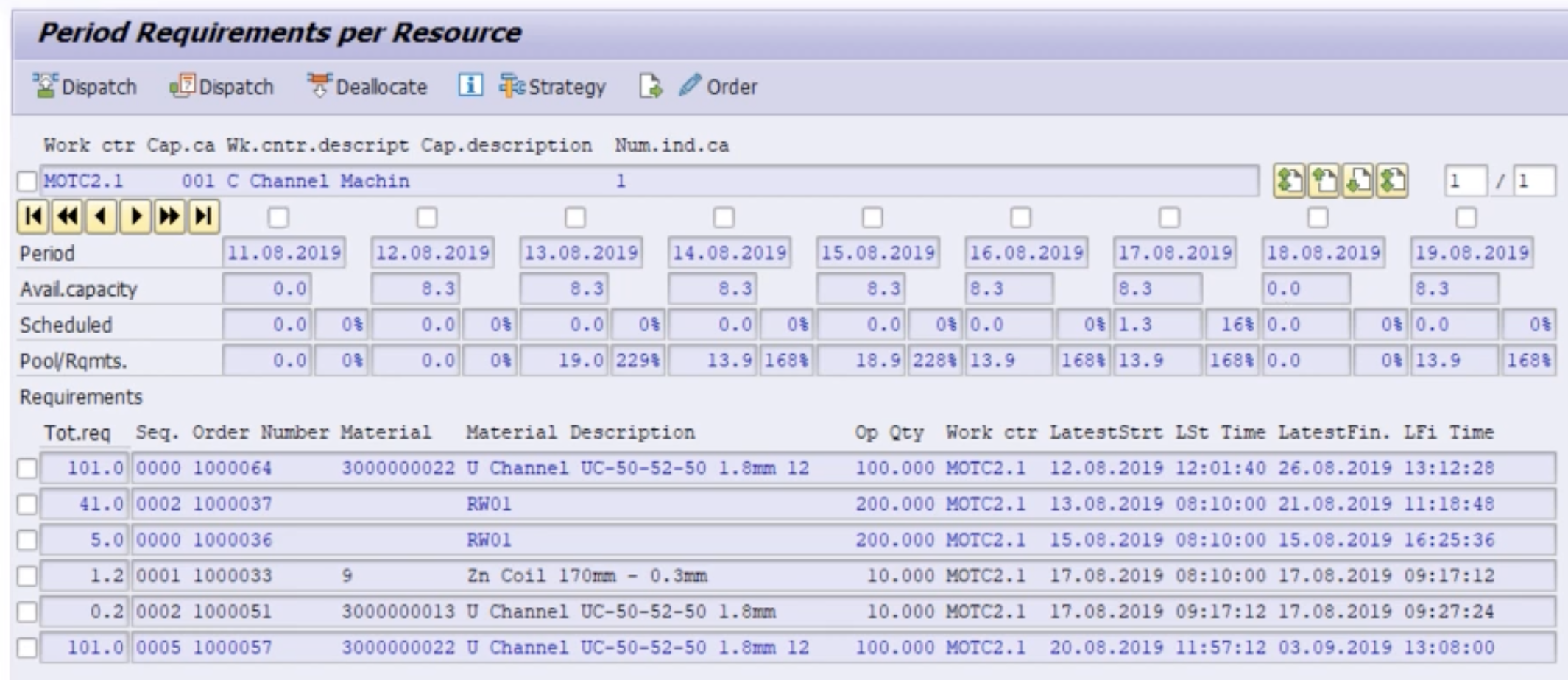
In practice, few planning teams live in CM25 day to day. Most open Excel, and the problems that stem from that are well documented:
- The plan lives in copies and emailed files, and there's uncertainty about which version is current.
- Move one job and every dependent row, formula, and linked sheet needs to be updated.
- When work finishes early, the hours stay blocked until someone frees them up.
- Visibility is managed by keeping separate sheets per crew or site, adding complexity.
- There is no audit trail, so nobody can tell who changed what or why.
- Nothing automatically reminds anyone of anything. Overdue work only surfaces when someone spots it.
In general, your Excel plan is a copy of SAP data, not a connection to it. It starts going stale the moment someone exports it, and keeping the two aligned is work that compounds over time.
These are the gaps dedicated planning software closes. Changes ripple through the plan automatically, capacity updates as work is completed, and SAP stays the single source of truth.
The 5 best SAP maintenance planning and scheduling software solutions.
Here is an overview of SAP-centric planning and scheduling solutions that we assessed in this comparison.
1. FastPlan by Arkyn
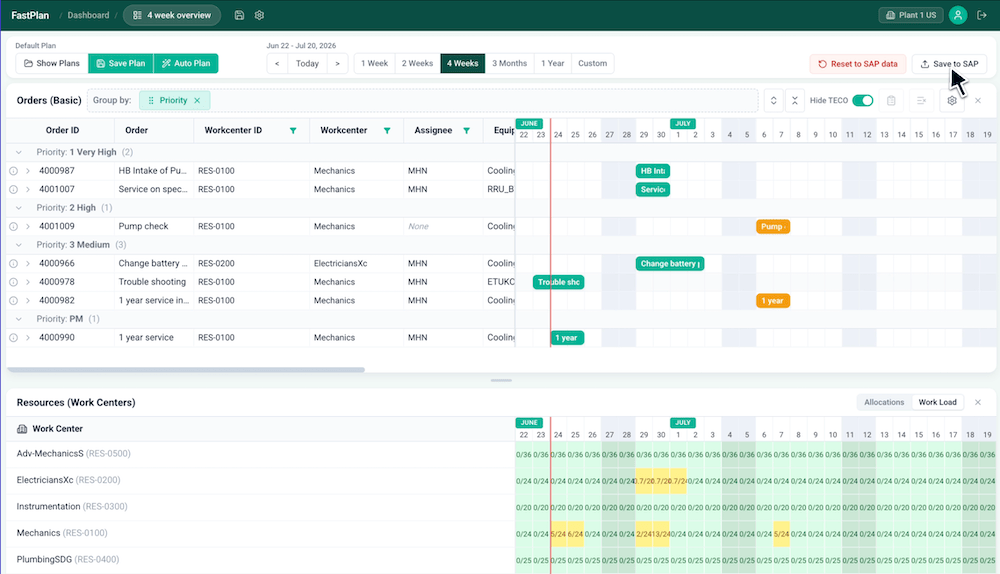
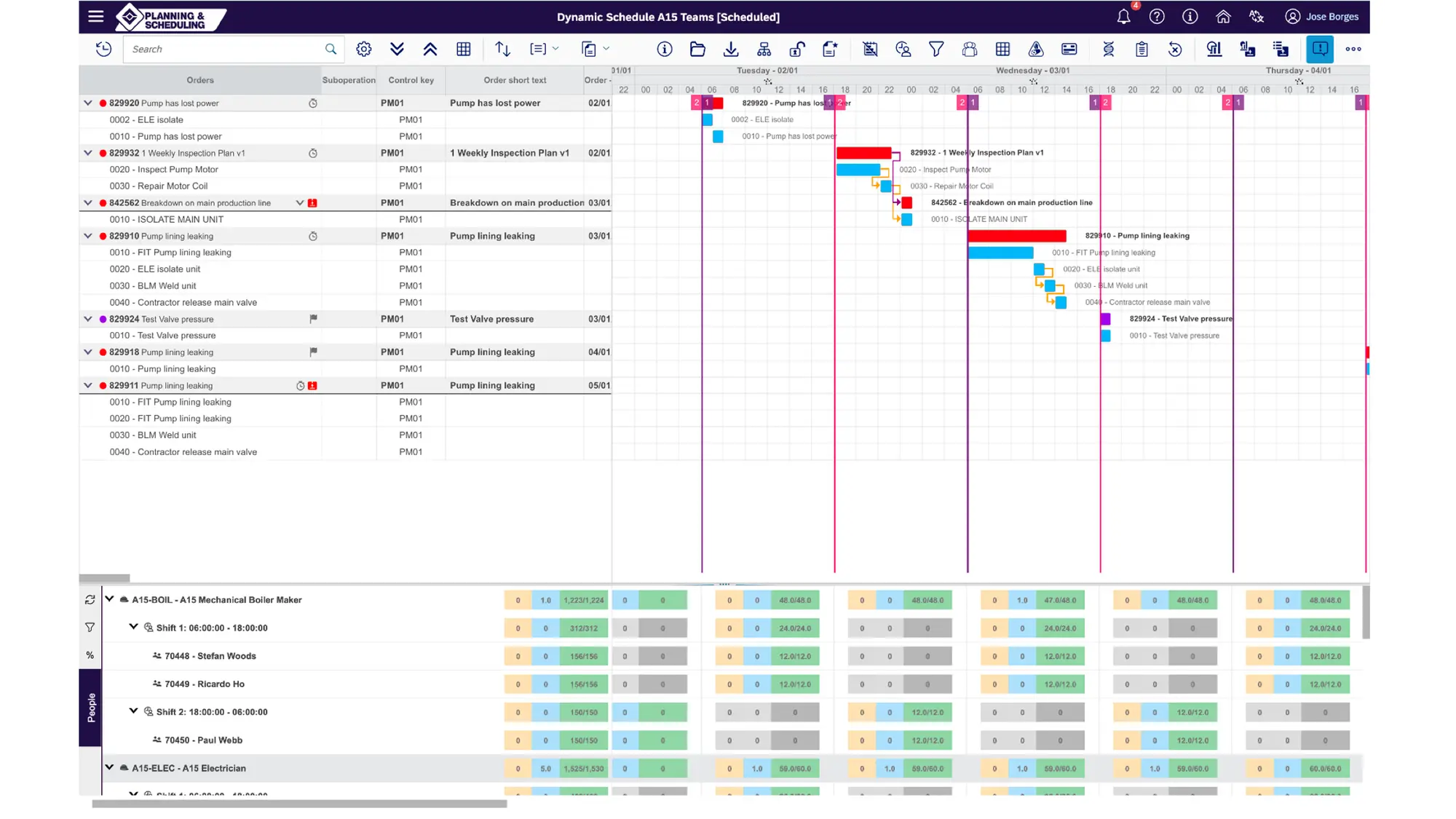
FastPlan is visual planning and scheduling software for SAP maintenance teams, and the planning product in Arkyn's FastApp Suite, which spans planning, mobile execution, digital forms, subcontractor management, and analytics.
It runs on via your browser and connects to SAP through FastCloud, Arkyn's integration platform built natively on SAP BTP, with no SAP core modifications and support for both SAP ECC and S/4HANA. Arkyn is an SAP OEM partner.
Put simply, FastPlan helps you build the plan visually, experiment freely, and commit to SAP when you are satisfied.
- Perspectives: Configurable planning views per role. Planners, schedulers, and resource owners each see what they need without anyone maintaining separate project sheets.
- Drag-and-drop scheduling: Move an operation or order and the hours, resources, and dependent work move with it.
- Live capacity: See who is available, adjust for absences, and spot bottlenecks while they are still small.
- Test runs before SAP: Try schedule changes without touching SAP, then save the plan with a test run once it holds up.
- Edit orders where you plan: Open any order to change it or its operations without leaving the scheduling view, or bulk edit many SAP work orders at once.
- Notifications in view: See open SAP notifications while scheduling and turn them into work orders without leaving the plan.
- More than SAP data: Not all planning data lives in SAP. FastPlan brings in outside sources for a complete picture.
Customers.
Arkyn's FastApps run at asset-heavy enterprises including Energy Transfer, where FastWork supports more than 8,000 technicians. Other notable customers include Arla, GoCollective, Vestas, and Döhler.
"The most impressive feature of the FastWork app is its intuitive design. You can pick it up and immediately understand how to navigate and use it," says Randall Grogan, Senior Director of IT SAP and Financial Applications at Energy Transfer. The same design discipline shapes FastPlan.
Pricing.
FastPlan is €250 per user per month, plus a FastCloud platform subscription starting at about €4,000 per month that covers the SAP integration, monitoring, operations, and updates across all Arkyn apps.
A team of ten planners lands around €6,500 per month all-in, but volume and bundle discounts are of course available. Every listed price in this comparison appears in the table above, several from the vendors' sap.com partner listings, so you can budget before a single sales call.
Pros:
- Fast go-live with pre-built SAP PM and CS coverage.
- Plans are testable before anything is written to SAP.
- Published pricing, with platform operations and updates included in the subscription.
- Consumer-grade usability means planners need little training to get going and everyday work goes faster once they are in.
Cons:
- Built only for SAP PM and CS teams. There is no standalone mode, so it is the wrong choice if some of your sites do not run SAP.
- No coverage for permitting, turnarounds, or master data governance. The FastApp Suite spans planning, execution, forms, subcontractors, and analytics for SAP maintenance.
2. Prometheus Planning and Scheduling (GWOS-AI)
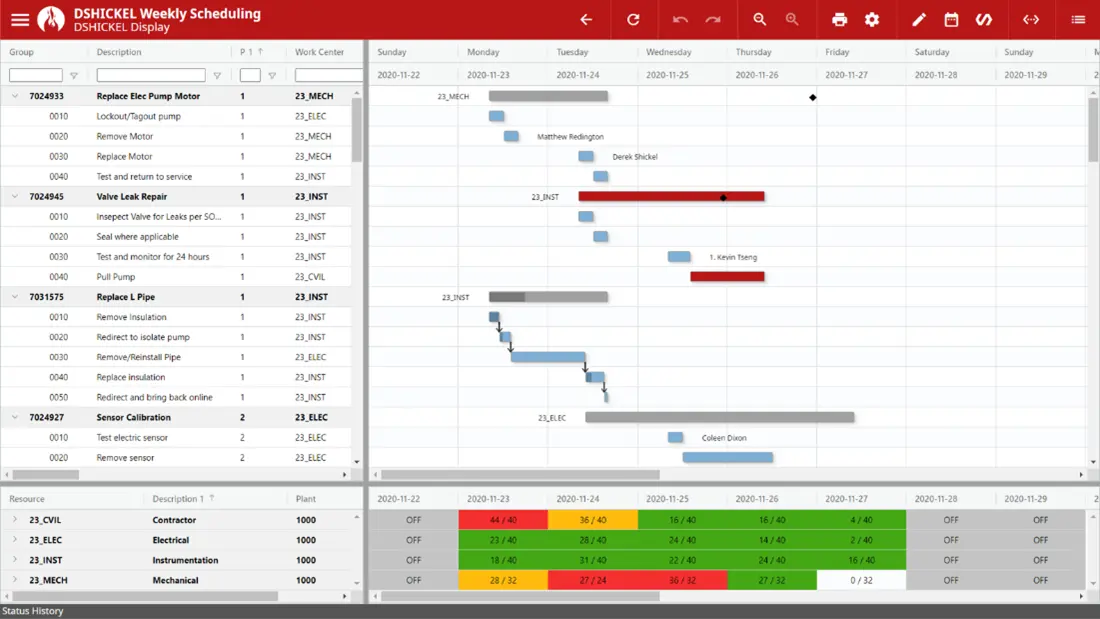
Prometheus Group has been building maintenance software on top of SAP since 1998, longer than any other third-party vendor in this comparison. Its Planning and Scheduling product, currently branded GWOS-AI, is a web-based graphical scheduler for SAP maintenance with drag-and-drop, direct editing, and role-configurable views. It connects to SAP ECC and S/4HANA through live, bidirectional integration and Prometheus is an SAP Certified Integration partner and an SAP Solution Extension partner.
Prometheus has invested visibly in AI. The company says GWOS-AI builds on more than 20 years of real-world maintenance data, and claims that planning work taking seven to nine hours in a native ERP can compress to minutes. Treat those as vendor claims and test them in your own proof of concept.
Pricing is listed on the product's sap.com partner listing: USD 8,500 per user per year for the Standard Version, plus a USD 100,000 setup fee and a five-year minimum contract.
A differentiator is reach beyond maintenance planning and execution. Capterra lists nine interconnected modules spanning planning, mobility, safety, contractor management, turnarounds, and master data, including a dedicated shutdown, turnaround, and outage product line. If you want one vendor for all of that, Prometheus stands ahead here.
Pros:
- The widest specialist maintenance portfolio in this comparison, reaching beyond planning into permitting, turnarounds, and master data governance.
- Deep SAP heritage: an independent review estimates about 80% of its customers run SAP.
- Named enterprise case studies, including Cameco.
Cons:
- Independent reviewers describe the platform as expensive and complex to implement, and a poor fit below roughly 200 employees.
- Planning and scheduling is one module of a large platform, so buying it is a project in itself. The listed terms reflect that: a USD 100,000 setup fee and a five-year minimum contract.
3. myPlanner by On Device Solutions
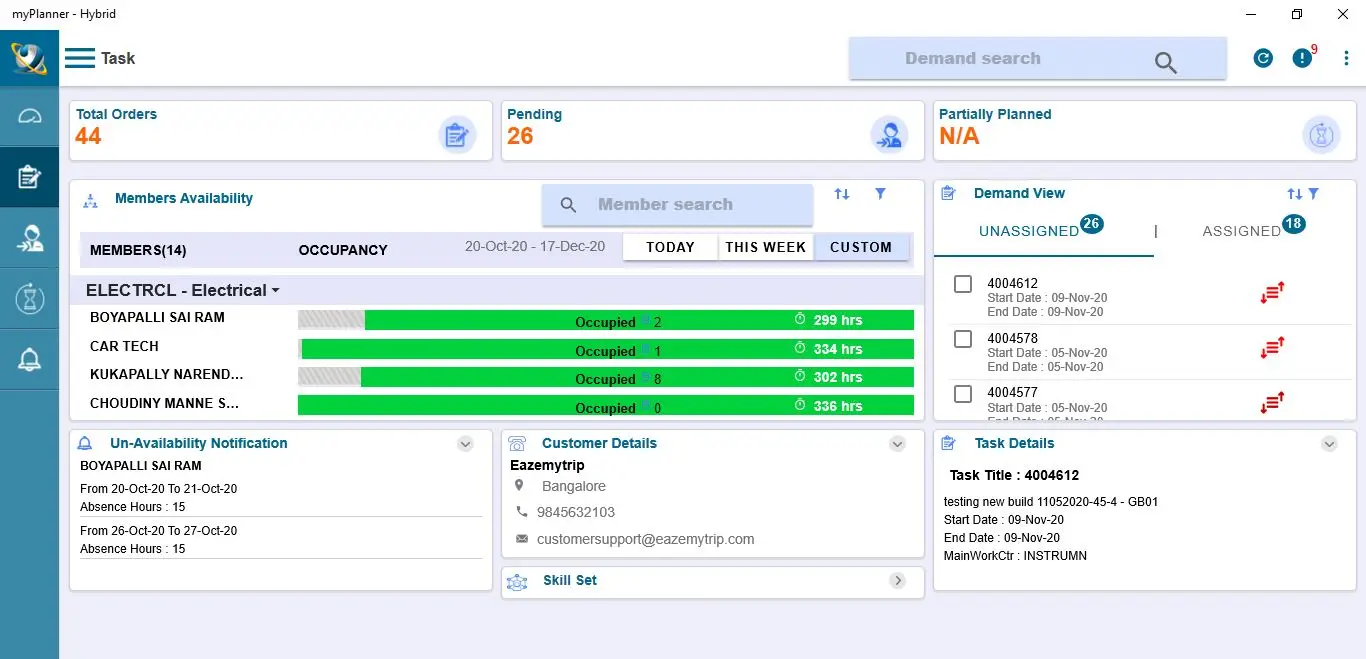
myPlanner is a planning and scheduling product from On Device Solutions, a UK-based SAP Gold Partner. It runs as an SAP-certified add-on inside SAP ECC or S/4HANA, is built with SAP UI5 on SAP BTP, and carries SAP's Clean Core certification, which matters if upgrade safety is a hard requirement.
Planners get a drag-and-drop Gantt view, work center and personnel assignment at both header and operation levels, and utilization views, accessible from desktop, tablet, and mobile browsers. On Device Solutions says deployment takes weeks, and lists clients including Engie, INEOS, BAE Systems, and Yorkshire Water.
Pricing is listed on the product's sap.com partner listing: USD 300 per user, one-time, for the Enterprise Edition, with a listed setup fee, a three-year minimum contract, and a one-month free trial that includes two users.
Pros:
- SAP-certified and Clean Core certified, running inside your SAP system.
- Deployment in weeks, per the vendor.
- Part of a suite that also covers mobile work orders (myJobCard) and digital forms (myForms).
Cons:
- The interface is built with SAP UI5. If your planners want the SAP look, that is a plus. If Fiori-style screens are part of what they are trying to escape, then this is not the correct path.
- On Device Solutions is also an SAP consulting business, so weigh product roadmap against services focus.
4. Sigga Planning and Scheduling
Sigga's Planning and Scheduling product replaces spreadsheet planning for SAP maintenance teams, with a distinctive strength in readiness. It organizes workload priorities up to three months out, adds a 52-week view for material purchases and resource allocation, and checks the availability of parts, people, and equipment before a schedule is finalized.
Actual team capacity is tracked week by week, with dynamic rescheduling when absences hit. It also handles mass updates of SAP records and schedule simulations. The wider suite adds mobile execution through EAM Empower, and Sigga primarily serves oil and gas, chemicals, utilities, food and beverage, and manufacturing.
Sigga describes both products as SAP-certified solutions serving SAP ECC and S/4HANA customers, and Planning and Scheduling has a partner listing on sap.com.
Pricing is listed on that sap.com listing: USD 1,350 per user license per year for the Standard Edition, plus a USD 90,000 setup fee and a one-year minimum. The license is based on the number of maintenance technicians deployed, and contractors can be managed at no additional charge.
Pros:
- Strong readiness logic: schedules are finalized only when parts, people, and equipment line up.
- Long planning horizons, with a 52-week view alongside weekly scheduling.
- A suite path to mobile execution with EAM Empower.
Cons:
- Thin independent review coverage: listing sites we checked showed no user reviews at the time of writing.
- Sigga's materials emphasize automation adapted to your rules, which implies configuration work up front. Scope that in the evaluation.
5. osapiens
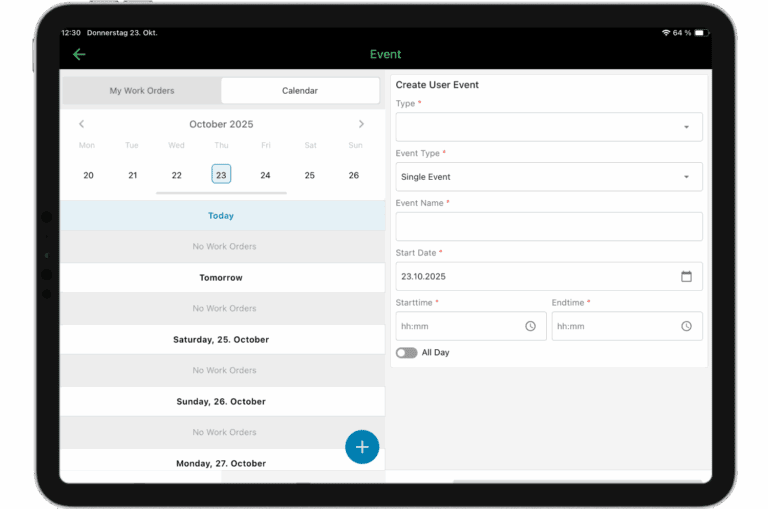
osapiens takes a different architectural path from everything above. It is a CMMS, built in Mannheim, Germany, by a company of more than 600 employees serving over 2,500 customers.
Its maintenance planner covers drag-and-drop work order assignment, skill-based matching, shift, absence, and on-call planning, and spare parts availability. The SAP link is a certified connector for PM, SD, and MM that supports both ECC and S/4HANA and syncs locations, assets, parts, and stock, and osapiens runs standalone, with SAP, or hybrid.
That architecture is the decision point. If SAP PM must remain the system of record for every order, the SAP-connected products above fit tighter. If you run a mix of SAP and non-SAP sites, or you want a full CMMS layer with SAP data flowing through it, osapiens is the strongest option on this list. It is also the only product here with a free tier: up to 5 users, unlimited assets, and 10 work orders per month.
osapiens represents this architecture in our comparison, but it is not alone: Fiix and MaintainX also offer SAP integrations for their CMMS platforms, and the same trade-offs apply.
Pros:
- Published pricing with a free plan, the only published free tier in this comparison.
- Shift, absence, and on-call planning handled natively.
- Works standalone, with SAP, or hybrid, which suits mixed tech stacks.
Cons:
- CMMS-first architecture: planning happens in osapiens, with SAP data synced through a connector, rather than SAP PM acting as the planning system of record.
- SAP depth is defined by the connector scope, which covers PM, SD, and MM data sync.
How we evaluated the planning solutions.
Five rules governed this comparison.
- We judged each vendor on its planning product alone. Wider portfolios appear where they affect your buying decision, but they earned nobody a better write-up.
- SAP integration was assessed on what each vendor documents: versions supported, certifications, and how data reaches SAP.
- Deployment claims are each vendor's own, linked and labeled as such.
- Transparency counts. Vendors that publish pricing and real documentation make your evaluation cheaper, and we weighted that.
- No star ratings. Review coverage in this niche is patchy: the Prometheus platform has reviews on Capterra, while listing pages for other products in the category show none at all.
And the disclosure once more: Arkyn builds FastPlan. Every claim about a competitor above links to that vendor's own materials, SAP's documentation, or a named independent source. If you work at one of these companies and we got a detail wrong, tell us and we will correct it.
How to choose.
If you want one vendor across planning, permits, turnarounds, and master data governance, and have a large implementation budget, then look into Prometheus.
The SAP look with Clean Core certification, running inside SAP: demo myPlanner.
Material readiness as the driving discipline: look hard at Sigga.
Mixed SAP and non-SAP sites, or a CMMS-first strategy: osapiens, MaintainX, or Fiix.
And if the goal is visual planning your planners will actually use, that adapts to how each planner works, goes live in weeks, and keeps SAP as your system of record, then check out FastPlan.
SAP RSH and MRS
SAP's own answer comes in two products, both licensed separately.
Are you on S/4HANA with a mandate to stay all-SAP? Evaluate RSH, and price in the transition, because SAP's consolidation into FSA ends RSH's roadmap at S/4HANA 2025 FPS0. On ECC with an MRS estate? SAP recommends existing customers continue for the time being, and the 2030 sunset belongs in any renewal conversation.
RSH, SAP S/4HANA Asset Management for resource scheduling, is the newer of the two: Fiori-based, embedded in S/4HANA Asset Management, and aimed squarely at maintenance planners, with a maintenance scheduling board and work center utilization apps.
MRS, SAP Multiresource Scheduling, is the long-serving add-on that many ECC maintenance teams run today.
In its product announcement for SAP Field Service and Asset Management (FSA), SAP consolidates five scheduling products, including MRS, RSH, and FSM, into one successor. MRS is in maintenance mode with no major enhancements and a planned sunset by December 31, 2030, and RSH's roadmap ends at S/4HANA 2025 FPS0.
As of September 2026, FSA is a work in progress. In release 2605, the shipped planning feature is a Workload and Capacity view. We cover the transition to FSA in our FSA explainer.
In short, you can see RSH as the natural successor to MRS for plant maintenance, with SAP FSM taking the field service side.
Pick the one that matches how you actually work.
Every product here does real work, and if your planners live in Excel today, any of them should be a step up in efficiency. The right one depends on your SAP landscape, how you buy, your budget, and how much implementation effort you can carry.
If you are interested in what we build: FastPlan puts your live SAP backlog, capacity, and schedule in one place, lets planners test changes before anything touches SAP, and writes every committed change back in seconds.
Contact us and share your own planning spreadsheet. We will show you what next week looks like in FastPlan.